
Getting Madison County Court Records
Start with two details: the exact Madison case and the item you actually need. Portal Smart Search can supply the public Case Summary. It also offers the case number, the division, an event, or a document already posted online. The unified Madison County Clerk of Superior Court holds Superior Court and District Court files. It also holds estate files, special proceedings, and the older paper court files. The state court-records information adds that clerk offices offer public self-service terminals. Paper files stay with the clerk in the county where the case lives.
- Use Portal or an existing file number to record the case number, division, type, and exact event or document sought.
- Decide whether the request is for available online case information, a filed document, a plain Clerk copy, a certified copy, a transcript, an audio record, or a different government record.
- For an ordinary public court file, call the Madison Clerk at (828) 649-2200 to confirm the temporary visit or mailing procedure, fee, payment method, and whether the record is paper or terminal-accessible.
- Use the reporter, transcriptionist, or court-audio process for a transcript or recording rather than requesting it as a routine file copy.
- Stop at the access rule for a sealed, juvenile, confidential, or otherwise restricted matter and follow Clerk or court direction.
Ask for a specific existing document rather than a broad retelling of a whole case history. Need the case number first? Try the public Madison County case lookup.
Madison County Court Record: Summary, Document, or Certified Copy
Three different things get called a court record. The Portal Case Summary, or Register of Actions, is an online public summary. It covers events and case information. A filed document is the pleading, order, judgment, or exhibit. It sits behind one of those events. A certified copy is different still: the Clerk authenticates it as an official court copy. A summary answers an informational question. When you need a court-authenticated record, only the certified copy will do.
| Record form | Primary channel | What it does not establish |
|---|---|---|
| Portal Case Summary | Public Enterprise Justice Portal | That every filed paper is available or that the view is certified. |
| Filed document or paper file | Portal when publicly available, otherwise Madison Clerk file | That restricted, sensitive, or older paper material is online. |
| Certified copy | Madison County Clerk of Superior Court | That a portal printout carries Clerk authentication. |
Obtaining Court Records is the Judicial Branch page laying out the clerk, terminal, and court-file routes for every county. The official image here reflects that same statewide court-record route.
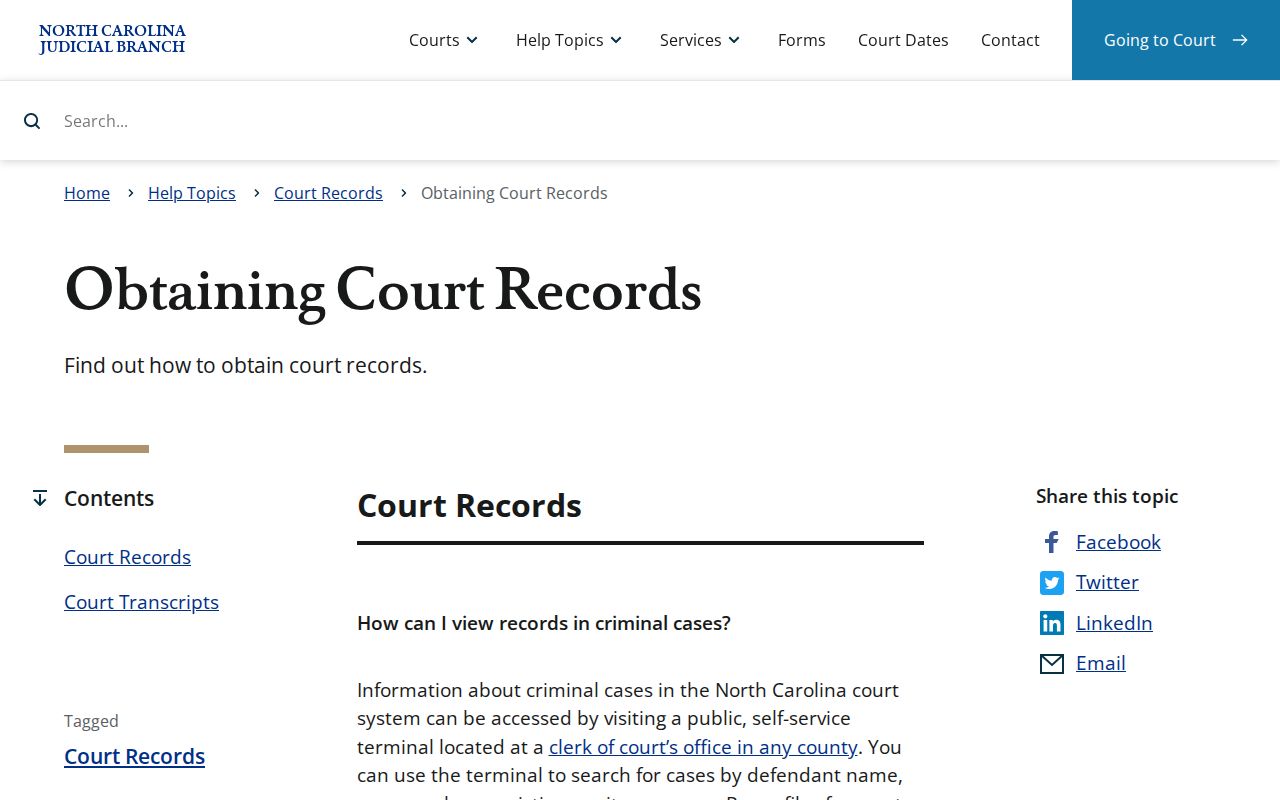
Decide between summary, document, and certified copy before you call the Clerk. Each one travels a different access path.
Court Record Types
For criminal, civil, estate, special-proceeding, and other Superior and District Court matters, the Madison Clerk is the first stop for the court file. But the record type sets the route. A police report belongs to the investigating agency. A deed sits with the Register of Deeds. A county executive record follows the county's own public-record process. These channels do not swap just because the items grew out of the same event.
- Criminal, civil, special-proceeding, and estate case files held through the Madison Clerk channel.
- Plain or certified court copies requested from the Clerk after the file and requested item are identified.
- Available online Case Summary information and public documents in Portal.
- Hearing transcripts obtained through the reporter or transcriptionist route.
- Non-confidential audio records, if available, through the Clerk’s AOC-G-114 process.
A Madison County public terminal can find a criminal file by defendant name, case number, victim name, or witness name. It cannot change what a record is. A transcript, a police report, and a certified copy stay separate record types no matter how you search.
Madison County Court Records That Remain Paper
Madison entered eCourts Track 9 on July 21, 2025. Portal then became the public channel for indexes, abstracted case information, and available documents. The transition was deliberate. Any document that already existed in paper at go-live stayed in paper form at the Clerk's Office. So a public case can show up in Portal. An older paper document must still be inspected or copied through the Clerk.
Upload and processing also affect what Madison County Portal summaries and images contain. A missing online document says nothing about the historical file. Check the document type first. Then look at the public-access status, the case number, and the Clerk channel before concluding a record is unavailable. One more program exists. The Remote Public Access Program is a separate statewide data and extract program under G.S. 7A-109(d) and (e). It is not a workaround for a Madison County paper file or a restricted document.
Ordinary Portal searching, a Clerk paper-file request, and the remote-access program serve different audiences. None of them expands access to sealed records.
Inside a Madison County Court Record
A Madison County Case Summary organizes the public information. The underlying file holds the documents behind those entries. Portal documentation describes what may appear: case-level information, parties, assignments, case events, dispositions, hearings, financial information, causes of action in applicable civil-like categories, and available public documents. Not every court record contains all of that. A given case may lack sections or an online image entirely.
| Case number | The structured identifier used to locate the matter in Portal and at the Madison Clerk. |
|---|---|
| Case information and assignment | Available basic record and court-assignment information shown in Case Summary. |
| Parties and cause of action | Public party detail subject to redaction; causes of action apply only to listed civil, family, probate, or mental-health categories. |
| Case events and hearings | Chronological procedural activity and any available hearings. Use current calendar channels for a live setting. |
| Dispositions and financial information | Available resolution and financial sections when Portal displays them. |
| Documents and certification | Available public Portal documents or Clerk-held filed papers; Clerk certification is separate. |
Note: Give the Clerk a precise case number, document title, and event date. That lets the office pull the existing record without guessing which part of a long file you want.
Madison County Court Record Requests at Carolina Lane
The Clerk and the courts sit temporarily at 258 Carolina Lane, Marshall, NC 28753. The historic courthouse at 2 N. Main Street is closed until further notice. Call the Madison County Clerk of Superior Court at (828) 649-2200 before any visit. Ask about a paper file, the public terminal, inspection, a plain copy, or a certified copy. Ask the clerk directly about terminal location. Also ask about current copy fees for judicial records.
Madison County Clerk of Superior Court
Temporary courthouse and Clerk office
258 Carolina Lane, Marshall, NC 28753
Mail: P.O. Box 217, Marshall, NC 28753
(828) 649-2200
Before traveling, ask the Madison County Clerk to confirm visit details, where the file currently sits, and whether the record is public and available. Time-sensitive facts change.
Madison County Court Record Transcripts Follow Another Route
A Madison County transcript is not a routine clerk copy. It is a word-for-word typed record made by an official reporter or transcriptionist. Before ordering one, gather the case number, the court date, and the exact proceeding. Then figure out whether that hearing had an official reporter, a digital recording, or no recording at all. Madison County sets no single transcript price, and not every hearing gets recorded.
For non-confidential audio, the Clerk route uses form AOC-G-114. Juvenile and other confidential hearings do not qualify. Those need court authorization through AOC-G-115. A general copy request cannot substitute for that authorization path.
Fees and Certified Copies
A certified copy of a Madison County court record carries the Clerk's authentication. A plain copy is just an informational reproduction. The court system posts no fixed copying or certification fee for case files, so ask the Clerk directly about the amount, payment method, and current procedure. The county government's posted copy fees apply only to County Manager executive records. They say nothing about a court case file.
| Request or copy | Amount located | Scope |
|---|---|---|
| Portal public case information | No search fee stated | Eligible public Portal information only. |
| Madison judicial plain or certified copy | Ask Clerk | The official judicial fee was not found in the reviewed sources. |
| County executive one-sided 8½ × 11 copy | $0.04 | County public-record policy, not the Clerk fee schedule. |
| County executive double-sided 8½ × 11 copy | $0.07 | County public-record policy, not the Clerk fee schedule. |
| County executive email or link of 10 MB or less | No charge | County policy only, not a court-file promise. |
| County executive special service | $27 per hour | In six-minute increments when qualifying work is required. |
The Judicial Branch publishes Current Court Costs as its official costs reference. It lays out state cost schedules. It does not set a Madison Clerk copy or certification price for a case file, so treat it as a reference rather than a fee list.
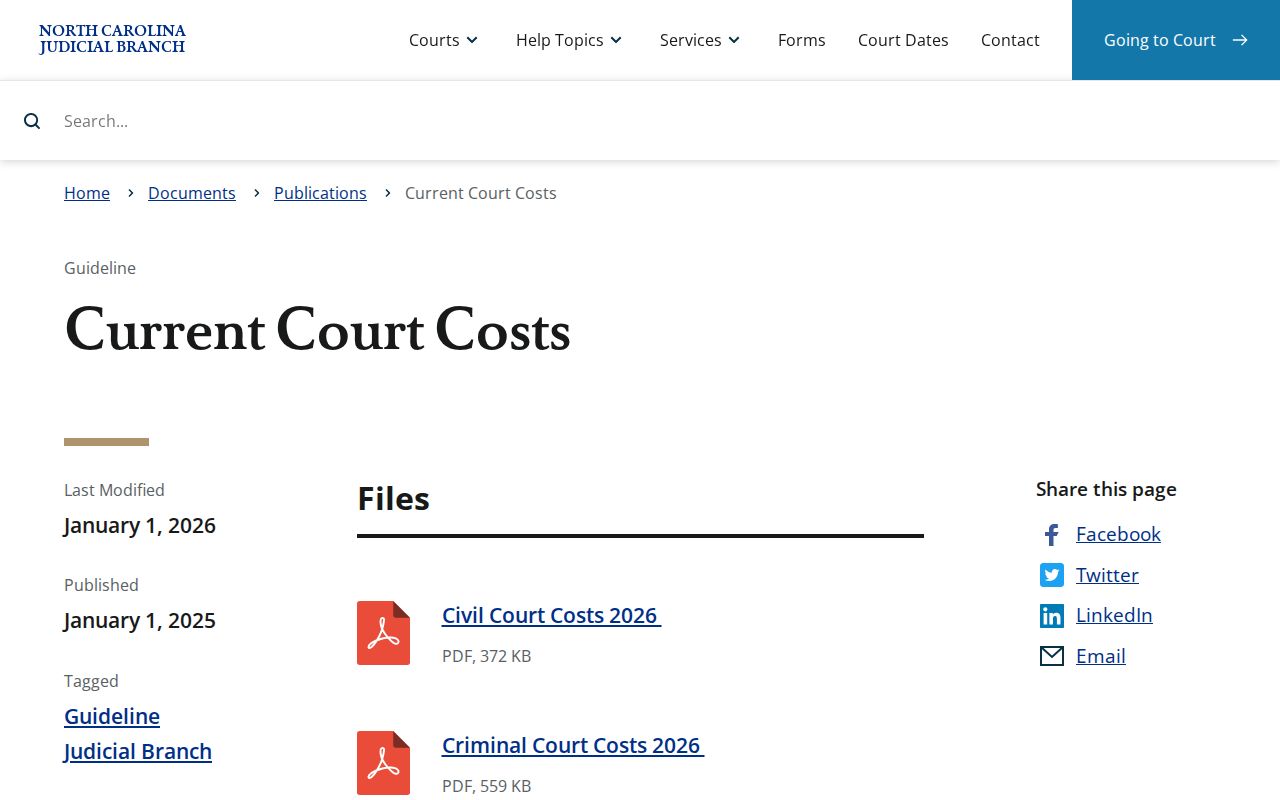
Confirm the actual Madison judicial charge before requesting a certified copy or sending payment.
Madison County Court Record Requests and the County Form
Madison County's government public-record request form covers County Manager departments and executive records. It does not reach judicial case files, which the Clerk of Superior Court holds. The county route takes written requests at recordsrequest@madisoncountync.gov or P.O. Box 577, Marshall, NC 28753. Policy calls for acknowledgment within two business days. When no extensive work is involved, follow-up normally comes within five business days.
None of that sets a deadline or fee for a court file. The county's $0.04, $0.07, email, and special-service fees belong to executive records. They do not go to the Madison Clerk. So match the office to the record. Use the county form for executive material. The Clerk route handles a Madison County court docket or case file. Madison County public-records request information is the official county-government source. It lays out this separate executive process.
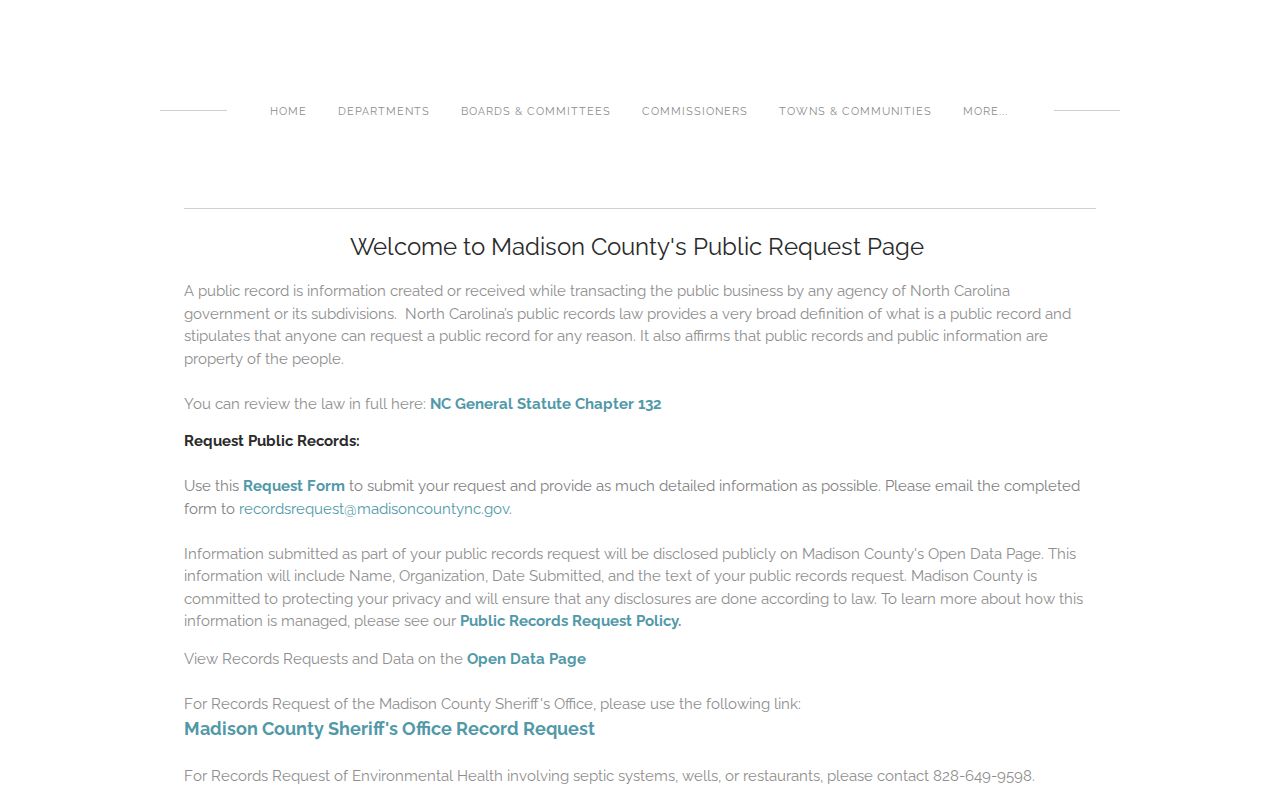
The county form has its place. It simply cannot pull a judicial case-file request away from the Clerk.
Sealed Records and Public Access
G.S. 7A-109 tells clerks to keep Madison County court records, files, dockets, and indexes open to public inspection. That access sits within legal limits. The Portal does not display sealed or confidential records, or documents with sensitive details. Restricted material can include juvenile records, unreturned warrants, certain protection-order categories, and confidential special proceedings. Registering with the Portal does not override those limits. Filing a broad public-record request does not either.
Public access rules:
G.S. 7A-109 directs Clerk recordkeeping and public inspection subject to restrictions prescribed by law.
North Carolina General Statutes Chapter 132 is the state public-records law, while court case-file access still follows the Clerk and judicial access rules.
For a sealed, confidential, or sensitive Madison court record, follow the specific court or Clerk instruction rather than trying another online or county-government channel.
Judicial Branch public-record request routes splits administrative records from case-file custody. That page spells out which office handles which request, which is exactly why the proper channel matters.
For an open Madison County court case file, stick with the Portal and the Madison Clerk. For restricted material, the legal access boundary is the end of the road.